The Great Wine Capitals Special Achievement Awards recognize outstanding lifelong accomplishments by wine tourism related companies.
During the Awards Ceremony and Gala Dinner marking the end of the 2023 Annual Conference of the Great Wine Capitals Global Network in Lausanne, the Vivanco Foundation received the Network’s third Special Achievement Award. The first award was in 2019 for La Cité du Vin (Bordeaux) and the second, in 2022 for WOW (World of Wine) in Porto.
Give Back to Wine What Wine Has Given to Us
This motto was the inspiration for the Vivanco family to create the museum and foundation and has guided the family philosophy since the museum’s opening in 2004.
Vivanco has been an important member of the Rioja wine community for three generations. The family owns and operates several wineries and a thriving grape and wine brokerage business.
A Roman mosaic showing Bacchus (Photo Tom Perry)
From wine presses to an impressive collection of art around the theme of wine culture
Co-owner Santiago Vivanco told Inside Rioja during the gala dinner in Lausanne that his father Pedro first intended for the museum to house his collection of antique wine presses. Pedro’s wife Angélica Sáenz and the rest of the family convinced him to broaden the scope of the museum to include a collection of wine antiques, sculptures and paintings where wine was the artists’ inspiration, as well as an impressive collection of corkscrews and recipients for drinking wine.
Five rooms and an outside grape garden
The museum occupies an area of 4,000 square meters (43,000 square feet), with five rooms and Bacchus’s Garden with 220 grape varieties planted.
A visit to the museum is a tour de force covering every aspect of wine culture. The Vivanco family is indeed giving back what wine has given them.
The tour begins in Hall One (Being Born, Growing, Maturing), relating the history of grape and wine culture from the beginning in the Caucasus region over 8,000 years ago to the present day.
Hall Two (Save the Essences) tells the story of the evolution of bottle, barrel and cork manufacture, with interesting audiovisual presentations about each product.
Hall Three (The Winery, the Dream): Here, the visitor discovers the processes carried out in the winery, among which are fermentation and the sensations of a wine tasting – color, aroma and taste as well as the transport of wine.
Hall Four (Wine, Art and Symbol) takes the visitor through art and archaeology from Egypt, the Greeks and Romans and the Judeo-Christian traditions.
An impressive collection of Roman mosaics, sculptures with intricately carved ivory inlays and paintings by world-renowned artists like Pablo Picasso, Joan Miró, Juan Gris, Joaquín Sorolla and others show how artists have used wine as inspiration for their works.
a ceramic pitcher created by Pablo Picasso
Hall Five (Open, Serve and Drink) houses 3,500 corkscrews from the time corks began to be used as closures to the present. There is a collection of glassware, bottles, decanters and other recipients to serve and drink wine.
These displays are impressive, even more so when you discover that what is shown accounts for only about a third of the family’s collection.
Wine goblets with ivory inlay
The museum also houses the headquarters of the Vivanco Foundation, and a documentation center with a vast library of wine books and magazines where scholars can carry out research on wine culture.
Visitors to the museum can enjoy a restaurant and gift shop as well as participate in wine tastings and courses.
There is a conference center and meeting rooms.
Numerous awards attest to the quality of the museum’s offerings
The museum and foundation have received numerous honors including several ‘Best Of’ Wine Tourismawards from the Great Wine Capitals:
2005 National and International awards for Art & Culture
2007 National award for Architecture, Parks and Gardens for Bacchus’s Garden
2008 National award in the Art & Culture category for the Documentation Center
2010 a national ‘Best Of ‘Wine Tourism award for temporary exhibits over nine years
2013 National and International awards for Art & Culture.
At the Lausanne awards ceremony, Santiago Vivanco, co-owner and president of the Fundación Vivanco and Vivanco Enoturismo y Experiencias, explained,
“We are extremely proud and happy to receive this award that highlights all the work done by the Vivanco family for over 20 years to share the culture of wine of our region and our country. It is an exclusive recognition that puts us on the map alongside most outstanding wine tourism destinations worldwide… This distinction is very important for us because it not only gives us a boost to continue our research and efforts to raise awareness, but also because it gives our wine and wine tourism culture the place we believe it deserves in the world.”
Vivanco Museum of Wine Culture and Foundation
Carretera Nacional 232
26330 Briones (La Rioja)
Opening hours:
Mondays: Closed
Tuesday-Wednesday-Thursday-Friday, Sunday: 10AM to 6PM
We have much more wine than we can drink. We haven’t bought much lately and prefer to draw down our large inventory of bottles unless we get a really serious recommendation.
The other day we decided to have steak for lunch. My wife started rummaging around our wine cellar and brought up a bottle of red that I didn’t even remember either buying or receiving as a gift. (Note to self: put tags on the bottles so we remember where and when we got it, and in the case of a gift, who gifted it.)
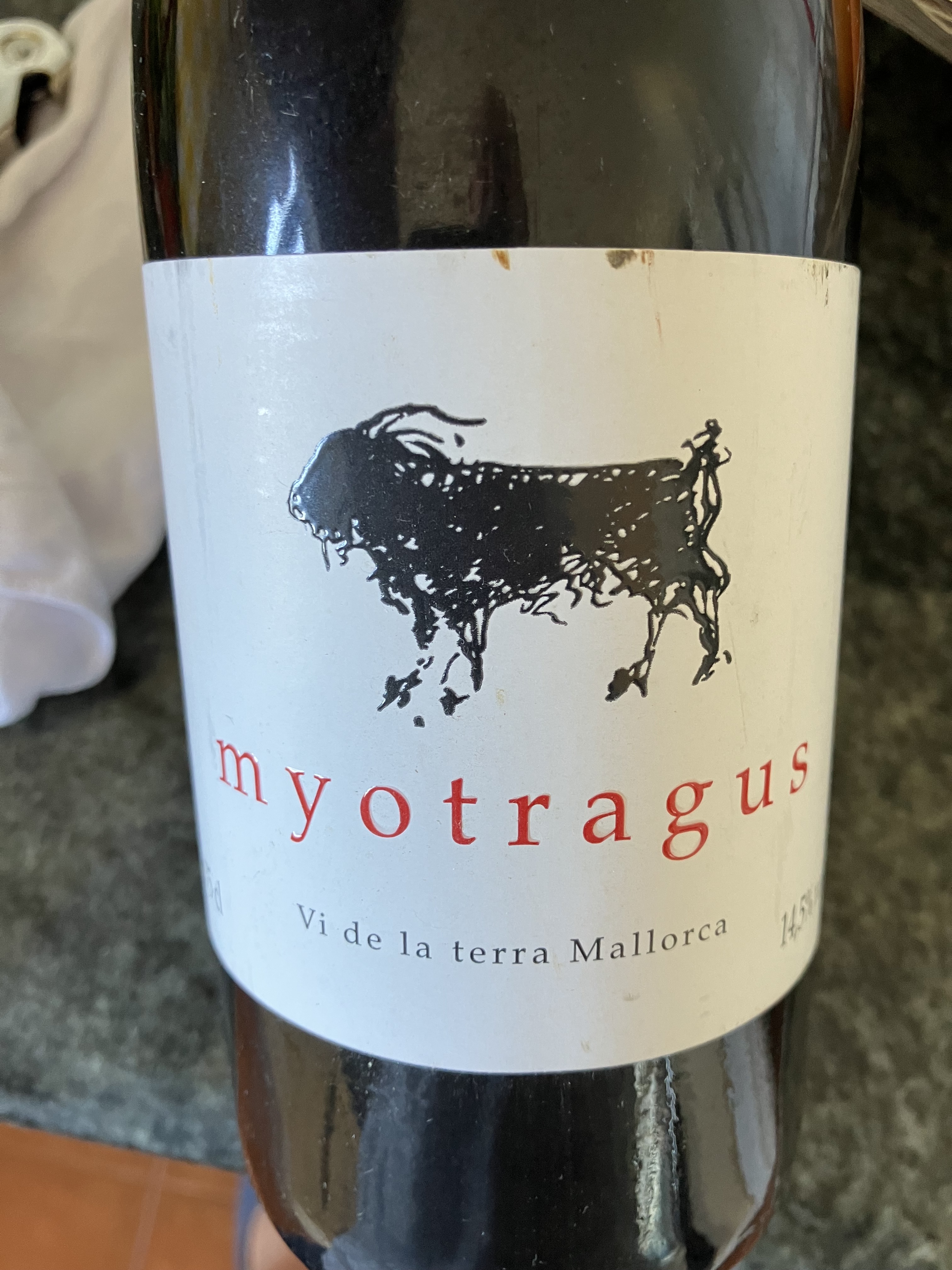
The bottle was Myotragus 2012, a ‘vino de la Tierra’ (regional wine from Majorca, one of Spain’s Balearic Islands in the Mediterranean).
The label, features a drawing of a shaggy-looking goat. My curiosity was piqued so I looked up ‘myotragus’ and discovered that it was an extinct genus (Myotragus balearicus, Bate 1909) of goat-antelope that lived on the Balearic Islands.
I thought the brand name and the label design were creative but was skeptical about the wine itself. Although it had been cellared properly, I thought “Eleven years old…it has got to be gone by now, but let’s open it and see. If it’s not drinkable, we use it for cooking or to add to our vinegar jug.”
Surprise! It was not only drinkable, it was great, showing mainly black cherry notes with a slight pruney aroma, a sign of slight oxidation. Full-bodied on the palate, it went very well with our steaks.
The back label said “red wine made from grapes from the local varieties callet and mantonegro, together with syrah, merlot and cabernet sauvignon. Aged in Hungarian, American and French oak for 15 months.”
I often wonder why winemakers feel the need to add international varieties to local grapes, especially in this case given the good reputation of both callet and mantonegro, but the blend seemed to work in this case. I reminded myself to look out for 100% callet in the future.
Perhaps my friend Mikel Hudin, who knows more about these wines than anyone else I know, can recommend a few.
I checked Vivino (https://www.vivino.com and learned that the wine was produced in 2008/09/10/12/14/16 and 2018 by the Pinavaley winery.
Wine Searcher(https://www.wine-searcher.com) revealed that the brand was theoretically available at Vinos y Yo on the island of Majorca. It might be more widely distributed but after ten years, a production run of 14,000 would probably be depleted.
In any case, if you happen to visit Majorca, take some time to look for this brand as well as others from the little-known but interesting appellations from the Balearic Islands.
A refreshing look at our city, how young people discover the world and not forgetting the things we take for granted
Logroño and the rest of the Rioja region – Rioja Alta, Rioja Alavesa and Rioja Oriental – recently received unexpected advertising support from a young American couple, the Smiths and their young son. The couple recently moved here from Kansas in the USA.
Photo credit: smithsinspain on Instagram
The Smiths relate their experiences on Instagram and TikTok, where they have 500,000 followers.
FIVE HUNDRED THOUSAND FOLLOWERS
When one considers that dozens of websites, regional governmental agencies, regional wine routes, the Rioja Regulatory Board and almost six hundred wineries promote the virtues of our area, the fact that one family and its TikTok account has such a huge reach is nothing short of amazing.
The Smiths are clearly in love with Logroño: the friendliness of the people, the relaxed ambiance, the fact that the city is walkable, the food, the wine, the affordability, it’s safe, it’s surrounded by mountains… In short, when readers ask, “Why Logroño?” The Smiths reply, “Why not?”
The latest post I’ve watched on TikTok shows Mrs. Smith reading a children’s book in Spanish to her young son Quinton, born in La Rioja and as Mrs. Smith says, “a Riojan”. It’s worth pointing out that the three members of the family are wearing matching pajamas.
In their Instagram account smithsinspain, Jess and Eric Smith were interviewed about their impressions of Logroño for six minutes on Zapeando, a popular national TV show. I can’t begin to imagine how much this would cost if it were a paid ad. Another Instagram reel showed the couple looking at apartments to rent.
ERIC SMITH DISCOVERS INTERESTING FEATURES OF SPANISH APARTMENTS
Once inside their apartment, Eric Smith discovered two unknown features: the portero automático, a telephone you use to identify a caller who buzzes your apartment from outside the apartment building – and that allows you to open the apartment building door.
Credit: Rade Telecomunicaciones
The second feature is persianas, interlocked plastic slats similar to venetian blinds but built into window frames, that you raise in the morning and lower at night.
Credit: Domondo
These features exist in every Spanish home, and we of course take them for granted. It’s amusing however to see a midwestern American’s amazement when discovering them.
When discussing this with my wife, she pointed out that she had read that new hotels have curtains rather than persianas in the windows because foreigners don’t know how to use them!
AN IMPORTANT MESSAGE FOR TOURISM AND WINE MARKETERS
This kind of easygoing, free advertising should make us rethink what young people – our future tourists and wine drinkers – are reading (or rather, watching) nowadays and how those of us who write about wine, food and tourism should tailor our communication strategy when addressing different age groups.
2022 was a great year to drink terrific bottles, some already familiar and others tasted during one of my wife’s and my trips around town, Spain, and the world.
I know that many of my fellow journalists list their favorite wines at the end of the year. I want rather to write about the underlying experience that added to our enjoyment of the wine.
The wines are described in chronological order.
Château Croix d’Allons, AOC Bandol (Fort Lauderdale Florida, USA) January.
A dear friend who lives in south Florida asked me to help him pour at the Seaglass Rosé Experience on the beach in Fort Lauderdale. I was already in Florida so I jumped at the opportunity. It was the first time I had poured wearing shorts and a tee shirt, a de rigueur outfit in this town. The only wines served were rosés from all over the world, attesting to the growing popularity of pink in the USA.
Of course, there were a lot of rosés de Provence at the tasting, but none was nearly as good as the Bandol we poured. Most Provence rosés are great for sipping, but this Bandol had weight in the mouth and a complex aroma.
I had, of course, heard of Bandol but it was an interesting experience to explain the wine to interested consumers. It was so successful that the distributor was able to get it on the exclusive wine list at the Fort Lauderdale Ritz-Carlton.
I’ve tasted a few Bandols since last January but none have been as good as Croix d’Allons.
Ilurce rosado (DOCa. Rioja) the house rosé at El Andén, a bar around the corner from our apartment building in Logroño. January.
Casimiro Somalo, a retired wine and agro-journalist at our local newspaper LA RIOJA, turned us on to Ilurce. He convinced the bar owner to buy a couple of cases, promising him that it would be a hit, which it certainly has been.
Ilurce rosé, a 100% garnacha, comes from Rioja Oriental. Not a pale Provence style. It showed darker color, weight in the mouth and crisp acidity, and more complexity than the typical “bubble gum” sensations one often perceives in a Rioja rosé. This is a great food wine.
Corte Bravi, Amarone della Valpolicella Classico 2017. Tasted at Cavò 24, Via Pelliciai 24 in Verona, Italy in April.
Verona is one of our favorite cities in the world. Where else can you see an opera in a Roman amphitheater and walk on streets that seem to be paved with marble?
Whenever we go to Verona we stop in front of a plaque on a building in the Piazza Bra. On the plaque is a quote from a famous speech where Giuseppe Garibaldi, the unifier of Italy in the 19th century shouted, “ROMA O MORTE” (Rome or Death) from the balcony of the building. Inspiring. But underneath the balcony, there was another sign that said “Affittasi” (For rent). Maybe a sign of the times?
While wandering through the old town we found Cavò 24, a tiny wine bar. We sat on the terrace, just two tables in a niche on a sidewalk in a narrow street. We LOVE Amarone and always try to drink it whenever we’re in northern Italy. This bottle was spectacular, with depths of aromas and flavors that got better with each sip.
The bar only had one bottle but promised more the next morning. We were waiting when it arrived!
Mauro Godello 2019. Vino de la Tierra de Castilla y León. (a gift from Mariano García after a meal at El Torreón in Tordesillas, near Valladolid). Received in June 2021 but tasted in June 2022.
Mariano García is arguably Spain’s most famous winemaker. He spent many years at VegaSicilia before launching his own brand Mauro in Castilla y León. Mariano has extended the Mauro brand to include a godello, one of Galicia’s (northwestern Spain) signature white varieties. This wine, however, comes from grapes vinified under the Vino de la Tierra de Castilla y León designation. Since Mariano seems to have the Midas touch with everything he makes, we were excited to try it.
My wife, a friend and I drank the bottle as part of our 49th anniversary celebration, one year after receiving the bottle. It showed a lot of complexity on the nose and weight on the palate. Like albariño, godello can be aged in bottle so my recommendation is that if you find a bottle, resist the temptation to open it immediately. You will be rewarded by waiting.
Pazo San Mauro (DO Rías Baixas),
Abel Mendoza malvasía 2021
Finca Los Locos Paraje Peñaescalera 2020
Restaurante Íkaro. Logroño. September.
A group of friends enjoyed a memorable lunch at Íkaro, a Michelin-starred restaurant in Logroño during the San Mateo wine festival. The guests included the owners of El Pañol, a top restaurant in Avilés in Asturias. We let Gerardo González, El Pañol’s wine buyer, choose the wines because distributors and wineries offer him thousands of bottles. Gerardo knows what’s good and what isn’t. Other wines he chose were Abel Mendoza malvasía 2021 (DOCa Rioja) and Finca Los Locos Paraje Peñaescalera 2020 from Artuke (DOCa Rioja).
Íkaro is owned and operated by chefs Carolina Sánchez from Ecuador and Iñaki Murua from Laguardia in Rioja Alavesa and as expected, their creations are inspired both by South American and northern Spanish cuisines. Gerardo González’s wine selections matched the cuisine perfectly, making it an unforgettable occasion.
Pazo San Mauro is a part of the Marqués de Vargas group and is consistently one of the best albariño-based wines in Galicia. Whenever we see a bottle on a wine list, we order it.
Abel Mendoza is known as one of the “bad boys” of Rioja, forever questioning the rules and pushing the boundaries. He and wife Maite make spectacular wines and their malvasía is one of my favorites.
Finca de los Locos was a novelty for me. I had heard of Artuke (the abbreviation of Arturo and Kike, the first names of the owners but had only tasted one of their other brands, PiesNegros, in bars around the city. Finca de los Locos was definitely a step up. A few days after the lunch I went to De La Rica, a wine shop in Logroño specializing in village wines and wines made from singular vineyards and bought a bottle.
Angélica Zapata 2018. Malbec Alta from Bodega Catena Zapata. Mendoza, Argentina, October.
I had plenty of opportunities to taste malbec-based wines in Mendoza during the Great Wine Capitals Global Network’s Annual Conference in October. I like them a lot because they are very tasty with black fruit notes on the nose and a complex palate that reminds me of forest floor and blackberries. Malbec is a good wine to drink with an Argentine asado – grilled beef (sadly often overcooked for my taste, since I’m used to aged beef that is seared on the outside and rare inside). But that doesn’t detract from the experience of standing around a table outside at sunset with your friends, a glass of wine, slices of cheeses and steak as well as other meats that make up an asado.
Catena Zapata is one of Argentina’s premier producers and everything they make is worth searching for. They enjoy good distribution both in the USA and Europe so you should have no trouble finding a bottle. Angélica Zapata is one of their top-of-the-range brands.
Ensamble. Valle de Guadalupe (northern Mexico DO) San Ángel Inn in Mexico City. November.
Every time I go to Mexico City, I make it a point to eat at the San Ángel Inn, located a few miles south of the capital. San Ángel is a beautiful Spanish colonial village that has been absorbed into the capital megalopolis. The restaurant is in a building that was once a pulque (an alcoholic beverage made from the sap of the maguey plant) distillery and the site of a famous meeting between Mexican revolutionary leaders Pancho Villa and Emiliano Zapata where they discussed how they were going to divide up the country between them. As students of history know, it didn’t end well for either of them.
Across the street from the Inn you can visit Diego Rivera’s and Frida Kahlo’s house and studio.
My wife had never been to the Inn. We were one of the first diners to arrive. As we ate and sipped, serenaded by a mariachi band, we watched as a procession of Mexican businesspeople, actors and actresses walked past our table. Toñica was thrilled!
Ensamble, as its name implies, is a complex blend of cabernet sauvignon and merlot with touches of petite sirah and barbera. The Valle de Guadalupe appellation of origin and its wines are worth seeking out. For those on the US west coast, Ensenada is just south of the border with California. The area has set up a wine route.
We enjoyed Ensamble with sopa de tortilla (tortilla soup) as a starter. I had a shrimp dish with a chocolate mole sauce, while Toñica ate braised beef tongue on a bed of stewed vegetables with a tomato and spicy pepper base (known as pisto in Spain). Our waiter gave us a funny look when Toñica ordered but she assured him that beef tongue was regular fare in Spain. It was delicious!
Viña Dorana reserva 2017. DOCa Rioja. Bodegas Gómez Cruzado. Tasted at an event at El Calado, an underground cellar in Logroño’s Old Town. December.
Viña Dorana is vinified from tempranillo (60%) and garnacha (40%) from the upper Najerilla valley in the southwestern corner of the Rioja appellation. The Upper Najerilla is quickly gaining recognition for its old vine garnacha, which has a different flavor profile than the garnachas from Rioja Oriental. The winemaker, David González stressed that Viña Dorana was created as a classic Rioja but with ageing in French, rather than American oak. It showed ovely red fruit with high acidity. González pointed out a paradox in the evolution in Rioja winemaking. After evolving away from the classic style, Riojas began to emphasize high alcohol, concentration, and jammy fruit while food was becoming lighter in style. Viña Dorana is meant as a return to a style where a couple can finish a bottle with a meal without tiring their palates.
The tasting was interesting because it was organized as a dialogue between González the winemaker and José Calvo, a dentist and amateur meteorologist about climate change and its effects on the Ebro valley and Rioja. Calvo confirmed that the immediate future would be longer, hotter, drier summers for our region.
Borsao Selección. Bodegas Borsao. DO Campo de Borja. 100 % garnacha. Bought at a closeout sale at one of our local supermarkets.
Fans of Inside Rioja know that I am wild about garnacha. Surprisingly, this wine, the little brother of Borsao’s delicious Tres Picos, was available at a discount and we scooped up every bottle in the store. I had never tried it before. We had a couple of bottles with our Christmas dinner and loved every drop. It has all the character of its big brother with an added dollop of fresh fruit.
Campo de Borja chose to keep its old vine garnachas while nearby Rioja Oriental decided to rip most of it out. This has proved to be a major mistake for Rioja, as pointed out by Álvaro Palacios who has made some spectacular garnachas from his family’s vineyards on the slopes of Mount Yerga near Grávalos. Today, garnachas from Rioja Oriental are taking a back seat to those from the upper Najerilla Valley.
Peña El Gato Natural. 100% garnacha. DOCa Rioja. Bodegas Juan Carlos Sancha. Tasted at a bar (Juan y Pínchame) on calle Laurel in Logroño’s old town. December.
Anything made by Juan Carlos Sancha is a guarantee of an unforgettable experience. He, along with fellow professors Fernando Martínez de Toda and Pedro Balda, was instrumental as the savior of several Riojan grapes on the verge of extinction, notably maturana.
When Sancha inherited his family’s vineyards at altitude near Baños del Río Tobía in the Najerilla Valley, he began to viniofy several plots of old vine garnacha, marketed under the brands Ad Libitum and Peña El Gato. His latest venture is a natural wine (i.e. with no added sufites).
Sancha says that to allow the wine to develop without adding sulfites, the grapes are allowed to ripen longer on the vine. The added alcohol protects the wine from spoilage.
My wife and I walked into Juan y Pínchame on Logroño’s calle Laurel to have their signature tapa, a skewer of grilled shrimp and pineapple. We were pleasantly surprised to see a panel on the wall advertising “high expression” Riojas that were served with a Coravin. We decided to choose Peña El Gato Natural, and it was a great glass.
This wine has apparently been available for several vintages. However, unless you’re a wine writer or a distributor, it’s not easy to find. I applaud the initiative of the bars in Logroño’s Old Town that offer these specialties by the glass. By doing this, the wines can gain a following by “ordinary” consumers as well as please wine writers passing through our area who can’t taste all the wines from Rioja’s 600-plus wineries, especially the wines from up-and-coming producers. I took advantage of that with several US journalists who recently visited our region and they were pleased to sample these wines.
Interested in sustainable wine tourism initiatives?
Join us at 4pm on December 14 for a fascinating webinar featuring four of the 2023 Best Of Wine Tourism award winners in the ‘Sustainable Wine Tourism Initiatives’ category.
The winners from Rioja (Bodegas Beronia), Porto (Six Senses), Mendoza (Rosell Boher) and the Casablanca Valley (Matetic Winery) will explain their award-winning sustainable policies.
Spain’s Ministry of Agriculture has recently approved twelve new applications for singular vineyard (Viñedo Singular) status from Rioja producers. This brings the total of singular vineyards to 133.
As a reminder, to attain singular vineyard status, the most important requirements for a vineyard are:
It must be located entirely within the limits of a town or village,
It must be over thirty years old,
The owner or lessee of the vineyard must present an agro-geological and climate study that explains why the vineyard is exceptional,
The vineyard must be harvested manually,
Maximum yields per hectare are 5000 kg for red grapes and 6922 kg for white grapes.
Wines produced from grapes in a singular vineyard, among other requirements, must have been vinified, aged, and bottled within the same winery, use a brand name exclusively for the wine, and obtain a rating of ‘excellent’ by a tasting committee made up of winemakers and other experts in Rioja.
A slow start for Singular Vineyards
The Viñedo Singular (VS) category has gotten off to a slow start in markets because of criticism over the application and approval process. The biggest obstacle to date however is the critical attitude of wineries that are traditional favorites of wine magazines and writers. These wineries can practically be guaranteed high scores in tastings where the producer and brand are visible to the taster. In the trade, this is called label bias.
An exciting branch of economics called ‘neuromarketing’ explains label bias in the wine business. I will deal with this fascinating subject in a future post.
Álvaro Palacios
The VS category has been given a huge boost with the news that Álvaro Palacios, Rioja’s most media-savvy winemaker, has gotten approval for his vineyard Quiñón de Valmira. This is a plot planted to garnacha on the slopes of Mount Yerga in Rioja Oriental. Readers of Inside Rioja will recall that Palacios announced several years ago, even before launching the brand, that Quiñón de Valmira would be a ‘game changer’ in Rioja.
Sure enough, since the first vintage in 2016, the wine has consistently received scores in the mid-to high 90s from the Wine Advocate and other media and tasters, propelling the retail price in Spain to almost 400 euros a bottle.
I hope that Palacios’ decision to include Quiñón de Valmira in the VS category will push other media darlings in Rioja to follow suit.
The wines from the Rioja region, although in high demand in northern Spain, were not highly regarded abroad. In his memoirs, the future Marquis of Murrieta, Luciano de Murrieta y García-Lemoine complained about their quality:
“I was in England with the Duke of La Victoria (General Baldomero Espartero), suffering the consequences of forced exile (from 1843 to 1848) because of our political ideas and constantly observing the esteem, that bordered on admiration, that was given to good wine. On my return to Logroño and seeing that in many cases wine was used to make mortar because it was cheaper than water, we felt pained that such a resource had a terrible image only because of awful winemaking…” (1)
Murrieta goes on to say that this inspired him and the Duke of La Victoria to create the winery known today as Marqués de Murrieta.
Luciano Murrieta y García Lemoine, Marquis de Murrieta (Photo from Los Vinos de Rioja, Manuel Llano Gorostiza)
Two unsuccessful attempts to adopt Bordeaux winemaking:
(I). Father Manuel Quintano, a native of Labastida in Rioja Alavesa and dean of the cathedral in Burgos
There were two unsuccessful attempts to improve the quality and aptitude for long distance shipping of wines from Rioja. Both looked to Bordeaux for inspiration. The first was by Manuel Quintano from Labastida in Rioja Alavesa beginning in 1787.
At that time wines from Rioja were fermented in open tanks using whole clusters of berries, including stems and seeds. The wine was decanted into wooden hogsheads for shipment and almost invariably arrived at its destination in an almost undrinkable state.
They were a badly vinified variety of the cosechero (semi-carbonic maceration) wines we know today in Rioja. Even in the 21st century, these wines are mainly sold in northern Spain because of their inability to age and travel over long distances.
Professor Alain Huetz de Lemps in an article from his book Vignobles et Vins du Nord-Ouest de l’Espagne describes the situation:
“…in the years when the harvest was abundant there was a serious problem of overproduction, since the disadvantage of these wines was their inability to keep for long periods, and of adulteration during long voyages. Shipping these wines by sea outside of Spain was impossible.” (2)
The Real Sociedad Bascongada de Amigos del País (Royal Basque Society of Friends of the Nation), one of the institutions created around the country to foment liberal ideas and modernize the country, were familiar with the great wines of Bordeaux. The Society commissioned a contest to determine the best methods to allow Riojan wines to be successfully shipped to Spanish America.
Quintano accepted the challenge and traveled to Bordeaux to observe winemaking techniques there. Among the practices he learned were:
Planting vines following the ‘quinconces’ pattern
Better vineyard husbandry including pruning to control vine growth;
Separating the stems and pips from the grapes before fermentation;
Using clean vats for fermentation;
Clarifying the wine with egg whites;
Racking the wine several times to remove solids;
Using small 225 liter oak barriques for ageing.
On their return to Labastida, Manuel Quintano and his brother Diego made wine following this method and were granted permission to ship it to the New World.
The shipment was a huge success. However, efforts to implant the Bordeaux method met with resistance from other wineries in the region because of the high costs of buying barrels and the financial cost of maturing wine for several years before shipment.
The controversy turned out to be favorable to the ‘traditionalists’ and against the ‘modern’ winemaking style. When the French invaded Spain in 1808, the project was forgotten.
(II).The Médoc Alavés
A half century later, a second attempt to learn to make wine following the Bordeaux method was the brainchild of Eugenio de Garagarza, the director of the Model Farm belonging to the regional government of Álava and a graduate of the agricultural school in Grignon in France.
In 1860 he recommended hiring a winemaker from Bordeaux to teach winemakers in Rioja Alavesa “the practices and secrets of the area of the Médoc”.(3) The regional government of Álava would finance the operation.
The man hired was Monsieur Jean Pineau, winemaker at Château Lanessan in Cussac-Fort Médoc. Pineau moved to Elciego in Álava and carried out his duties admirably, instructing the winery owners who participated in the project. The wines were excellent, but just as with the Quintano project, most of the wineries thought that the cost was too high. Pineau’s contract was rescinded in 1868.
A bottle of Médoc Alavés from 1874. The bottle is on display at La Granja Remelluri in Rivas de Tereso
The Marquis de Riscal hires Pineau
Fortunately, one of the participating winery owners was Camilo Hurtado de Amézaga, the Marquis de Riscal. He hired Pineau, built a winery according to Pineau’s specifications and soon Riscal’s wines were winning medals in international competitions. Others noticed. The Bordeaux method had taken hold.
Phylloxera discovered in France and demand for wines from Rioja soars
The phylloxera plague began to decimate French vineyards in 1865 and consequently, demand for wines from Rioja increased, with new vineyards planted to meet the demand. According to Ludger Mees, the vineyard area in the Alto Ebro region (La Rioja, Álava and Navarra) increased 79% between 1860 and 1890. (4)
the phylloxera aphid (Wikipedia)
It was in the context of this increased demand for wines vinified in the Bordeaux style that many wineries were founded in the last third of the 1800s.
In his book De Goede Wijnen van Rioja (1985), Dutch wine writer Hubrecht Duijker published a list of the earliest ‘modern’ wineries founded in Rioja (5)
# = a winery in Haro
## = a winery in the Haro Train Station District
185? Marqués de Murrieta
1860 Marqués de Riscal
1861 Faustino Martínez
1870 Rioja Santiago ##
1874 Bodegas Montecillo
1877 R. López de Heredia Viña Tondonia ##
1877 Berberana
1879 Compañía Vinícola del Norte de España (CVNE) ##
1880 Martínez de Ayala
1881 Bodegas del Romeral (now Bodegas AGE, part of Pernod-Ricard Winemakers Spain)
1882 Muerza
1885 Lagunilla
1886 Duque de Moctezuma (today Bodegas Gómez Cruzado) ##
188? S.M.S. (now Bodegas de la Marquesa)
1890 La Rioja Alta, S.A ##.
1890 Bodegas Franco-Españolas
1890 Martínez Bujanda
1890 Bodegas Riojanas
1894 Bodegas Palacio
1895 Martínez Lacuesta #
1895 De la Torre y Lapuerta (now Bodegas Campo Burgo)
1896 Carlos Serres #
1898 Federico Paternina
1898 Corral
1901 Bodegas Bilbainas (merger with Savignon Frères, founded in 1859) ##
Later, two other wineries were built in the Train Station District:
1970 Bodegas Muga (founded in 1932 with a winery in the center of Haro)
1987 Bodegas Roda
By adopting the Bordeaux method of winemaking and ageing, Rioja and Bordeaux have been inextricably linked for over 150 years. The epicenter of this link is the Haro Train Station District, the largest concentration of one hundred-plus year old wineries in the world.
Bodegas La Rioja Alta celebrates its 125th anniversary in 2015 (Photo Tom Perry)
In Part 3 of this series, we will examine the Haro Train Station District today and its homage to Bordeaux at the Barrio de la Estación International Wine Encounters (BEIWE) on March 21, 2022. At this event, a winery from each of six prestigious Bordeaux appellations – Saint-Estèphe, Pauillac, Saint Julien, Margaux, Pessac-Leognan and Saint-Émilion will show their wines alongside six wineries from Hero’s Train Station District.
Footnotes to Part 2
Llano de Gorostiza, Manuel. Los Vinos de Rioja. Induban, page 62.
Huetz de Lemps, Alain. La Lucha Tenaz de Don Manuel Quintano en favor de la calidad de los Vinos Riojanos.
Llano de Gorostiza, op.cit. page 67.
Mees, Ludger. La Vitivinicultura en Navarra y La Rioja: Economía, Sociedad y Política de Intereses (1850-1940). Published in Gerónimo de Uztariz, boletín 6, page 154.
Duijker, Hubrecht. De Goede Wijnen van Rioja. Uitgeverij Het Spectrum, page 40.
The development of the steam locomotive in England in the early 19th century was one of the most important drivers of the Industrial Revolution. By the middle of the century there were more than 10,000 kilometers of railway lines in England, France, the German and Italian States, the Austro-Hungarian Empire and Russia. (1)
Spain was eager to adopt this modern means of transportation.
However, despite the governments’ progressive leanings, finances were in a sorry state following a severe economic crisis in 1847 and 1848 so official financial backing for rail lines was lacking.
According to Carlos Larrinaga, the absence of projects “was not due to a lack of initiatives but rather of capital”. (2)
Unable to raise capital, governments in Spain offered concessions to private investors. In the case of railroads, several of these capitalists were French, such as the Rothschild and Perère families as well as Spaniard José de Salamanca. Once a concession was granted, the investors provided capital with their own funds and by means of stock and bond issues. In exchange, the companies received a percentage of the price for shipping freight for a certain number of years.
Northern Spanish ports compete for concessions
Ports on the coast of the Bay of Biscay competed to link them with central Spain. Some of these projects, such as a line from Alar del Rey to Santander and another from Castile via Soria, La Rioja, Pamplona and Bayonne in southwestern France via the Alduides valley were unsuccessful in spite of strong regional support due to fundraising problems and central government opposition.
The passing of a national railway law in 1855 laid the groundwork for a network of rail lines radiating from Madrid following a plan from the time of king Carlos III.(3) The most important of these lines was to link Madrid to the north coast.
Bilbao, capital of the province of Vizcaya, competed strenuously in favor of this line passing through the city and port but its initial aspirations were frustrated. The project finally approved called for the northern end of the Madrid-Bay of Biscay route to be at Pasajes near the French border, not Bilbao.
Bilbao gets its train line
Bilbao later succeeded in receiving a concession and funding for the last stages of a rail line linking Spain’s major industrial regions of Catalonia and Vizcaya (Bilbao). This line followed the course of the Ebro River to Miranda de Ebro and then north. By the beginning of the 1860s, it reached from Catalonia to Tudela in Navarra, with the last stage, from Tudela to Bilbao, completed in 1864.
This line connected with the Madrid-French border railway in Miranda, allowing goods to be shipped by sea from Bilbao and Pasajes and overland through France from the border town of Irún, the terminus of the northern line.
The project had strong political support from the Riojan civil engineer and congressional deputy Práxedes Mateo Sagasta as well as financial backing from the provincial government of the province of Logroño and investors from Vizcaya including the recently created Banco de Bilbao (1857).
The line was not only a means to ship industrial goods to and from Bilbao and Barcelona but also foodstuffs from the fertile valley of the Ebro River, including wine from Rioja. Haro, in the province of Logroño (today La Rioja), was a stop on the line and the land around it was where the winery district soon developed, although the train station was not officially opened until 1880 (4).
Phylloxera in France attracts French buyers in search of wine
Numerous French agents began to visit the region in search of wines to export to France, whose vineyards had been ravaged by the phylloxera plague. Some of these French agents decided to stay in Haro, including Messieurs Heff, Anglade, Blondeau, Dupeyron, Foisier, Lavatout, Lepine, Savignon, Serres and Vigier. (5) The first winery in the station district, an association of the Alsatian Armand Heff and Spaniard Rafael López de Heredia, was founded in 1877. (6) Other winery investors followed suit.
Rioja wines needed to improve
From 1864, date of completion of the line to Bilbao, wines from Rioja had a faster route to Bilbao to satisfy increased local demand, and for exports via seaports in northern Spain and overland to France. But as we will see in Part Two, winemaking had to evolve to satisfy the demands of French wineries, Rioja’s most important customers.
a 19th century steam locomotive on the grounds of Bodegas Muga in the Train Station District (Photo courtesy of Bodegas Muga)
Footnotes:
José Manuel Delgado Idarreta. 150 Años del Ferrocarril en La Rioja.
Carlos Larrinaga Rodríguez, “Las conexiones ferroviarias entre las Provincias Vascongadas y Navarra a mediados del siglo XIX”. Revista Huarte de San Juan. Geografía e Historia 10, 2003, p. 16.
Delgado Idarreta, op.cit.
Llano Gorostiza, Manuel. Los Vinos de Rioja. Induban, 1973, p.74.
De Candamo, Luis G. R. López de Heredia Viña Tondonia. Biografia del Rioja Supremo. 1996, pp. 76-77.
Wine – it’s such a complicated subject. If we venture beyond the ‘either I like it or I don’t’ phase, we need an expert’s help to attempt to fathom its mysteries. Enter the wine writer.As far as I know, no other fruit has been so meticulously dissected as the grape and its fermented liquid. I tip my hat to the men and women who have worn out their elbows studying, their suitcases and salaries from traveling and their palates from tasting and reporting on the mind boggling variety of wines made around the world.
The topic of Rioja is no exception, although our output dwarfs those books written about Bordeaux, Burgundy and Champagne. There is, however, a devoted group of journalists who specialize in our region, fighting for attention in newspapers, with publishers and in the fast-expanding world wide web.
The latest addition to this select library of publications about Rioja is Fifty Years of Rioja – The Region and its Wines between 1970 and 2020 by Jeremy Watson, who I am proud to say has been a dear friend and colleague since my earliest days in the wine business almost fifty years ago.
Watson’s book is out of the ordinary in several ways. First, because it is a personal memoir of his countless visits to Rioja. He lovingly portrays the charm of the region, the Riojan people, gastronomy and of course, wine. It is also an unfiltered, no holds barred look at how business is transacted in Rioja as seen through the eyes of an Englishman.
The book tells of Rioja’s triumphs, mistakes and scandals.
Watson’s book chronicles the huge changes that have taken place in Rioja’s infrastructure with the transformation of the wine business from a group of small wineries to huge conglomerates that were built, bought, sold and re-sold. Wine shipped in tanks to be bottled in the UK, Sweden, Belgium and Switzerland gives way to 100% Rioja bottling, but not after a nasty court fight at the highest level in the European Union.
The book explores new categories – wines from single vineyards, single village wines and single zone wines – created to complement Rioja’s traditional classification of “guarantee of origin”, crianza, reserva and gran reserva. Watson dissects the fight over approval of new grape varieties – do they improve the quality of Rioja or are they concessions to fads?
In addition, Watson takes a detailed look about Rioja’s acceptance through the years in the United Kingdom market and his experience of marketing Spanish wines in the UK from his post of Director of Wines from Spain.
Here you can read about
Rioja’s fickle weather patterns and how climate change has affected grapegrowing;
the scandal surrounding the Spanish conglomerate Rumasa and its purchase of several Rioja wineries;
what happens when banks run wineries;
the economics of ageing in oak barrels;
the debate about singular vineyards;
does Rioja still show a typical style?
hospitality, Riojan style;
and many other topics.
Most wine books are snapshots of wineries that eventually become outdated. What makes Watson’s book unique is his eyewitness account of happenings in the Rioja wine business and in the region itself over a half century.
Fifty Years of Rioja: The Region and its Wines between 1970 and 2020 by Jeremy Watson is available from Amazon. In the UK, the paperback addition sells for 6.93 GBP and the Kindle edition for 3.00 GBP. In the USA it is currently available for 3.96 USD with the paperback to follow shortly.
Miguel Merino, founder of Bodega Miguel Merino, passed away on October 31 after a long illness.
Most people in Rioja today knew Miguel as the jovial owner of the winery he founded in 1994. Miguel however, was a 44 year veteran of the Rioja wine trade, having begun his career as one of the two export directors of Bodegas Berberana, at that time one of Rioja’s powerhouses along with Paternina, AGE and Savin, the parent company of Bodegas Campo Viejo.
I met Miguel shortly after my arrival in Rioja in 1983 as the export director of bottled wines for Savin and we soon became friends because of our mutual love of wine and music, more specifically, rock and roll.
Because we traveled most of the time we used to joke that we saw each other more often in New York, London and Stockholm than in Logroño. It was an incentive to meet at home more often between trips.
Berberana was bought by Rumasa in 1980 and after a few years with the winery under its new owners, Miguel, along with his former managing director Melquíades Entrena and another executive, Félix Pérez, founded Cenalsa, an export consortium. Miguel soon tired of driving back and forth from Logroño to Pamplona and fighting to get distribution for the wines he represented in an increasingly competitive marketplace, so in 1994 he founded his own winery in Briones.
Today it’s not uncommon for a winemaker or a grape grower to found a winery, but Miguel was neither. His decision was both gutsy and risky, but he never looked back. He sought advice from experts – for winemaking, Manuel Ruiz Hernández, the longtime technician at the Haro Enological Laboratory; for grape and wine supply the powerful broker Pedro Vivanco; and from friends like Lars Torstensson, one of the two former wine buyers at Sweden’s Vin & Sprit. The other buyer, Arne Skog, became Miguel’s distributor in Sweden when Skog founded Domaine Wines & Spirits.
Miguel’s philosophy was to have fun with his wines and his winery, vowing only to do business with friends and former customers. To visit him was to be regaled with stories about his adventures as a wine salesman and countless jokes and anecdotes as you sat around the table in his tasting room.
Miguel telling a storysoon after founding the winery
Among the many stories he told, one stands out in my mind. Miguel was at a wine fair negotiating with a German-speaking buyer, ostensibly for a discount supermarket chain. Miguel saw that there was no way he could make a deal, so when the buyer was leaving, he told Miguel “Auf wiedersehen” (‘goodbye’ in German). Miguel answered, without missing a beat, with the similar sounding “¡Olvídense!” (‘forget it’) in Spanish!
As I mentioned earlier, Miguel’s other love was rock and roll, developed during a yearlong stay in the USA as an exchange student. Throughout his life he referred to his hosts as “my American family” and he visited them as often as possible.
Miguel and I used to listen to music at a home he owned in Trevijano in the mountains southeast of Logroño. This was long before the internet so we relied on the 45 and 33⅓ rpm records in our collections. There was one particular song we couldn’t find: 96 Tears by ? And the Mysterians, one of Miguel’s favorite’s. He finally found a copy. Whenever I hear it I think of Miguel.
Miguel was a pioneer in his winery with the launch of Mazuelo de la Quinta Cruz, a plot of the mazuelo grape variety near the fifth station of the Via Crucis on Monte Calvario (Mt. Calvary) near Briones. Lars Torstensson, who had become the director of Domaine Rabiega, Vin & Sprit’s winery in Provence, was experimenting with carignan (a synonym for mazuelo), so they decided to make a 100% mazuelo, Rioja’s first. It became popular in Spain because of a listing at Andoni Luis Aduriz’s two Michelin-starred Mugaritz near San Sebastian where it was paired with dishes that defied pairing with other wines. Quinta Cruz gained notoriety internationally, too as Decanter magazine’s “Best Old World Red” in 2007.
Miguel’s grape selection process echoed his sense of humor. As the grapes were unloaded onto the sorting table they were inspected. One of three possible events occurred: the unsuitable grapes were thrown into a bucket called ‘infierno’ (hell), the doubtful grapes were thrown into another bucket called ‘purgatorio’ (purgatory) and the other grapes – ‘cielo’ (heaven) were allowed to pass through to the destemmer/crusher. The good grapes would become Miguel Merino wines and the ‘purgatory’ grapes made into a second, inexpensive product for workers in the winery and friends.
Miguel’s legacy is guaranteed with Miguel’s son taking over operations at the winery along with wife Érica.
With Miguel’s passing, Rioja has lost one of its most endearing and lovable characters. Rest in peace, my friend.




 Inside Rioja